3PL best practices
Everything Ships Better From Texas
Why brands nationwide pick a Texas 3PL: fewer far shipping zones, major carrier hubs, and cheaper warehouse space. Published rates, no monthly minimum.
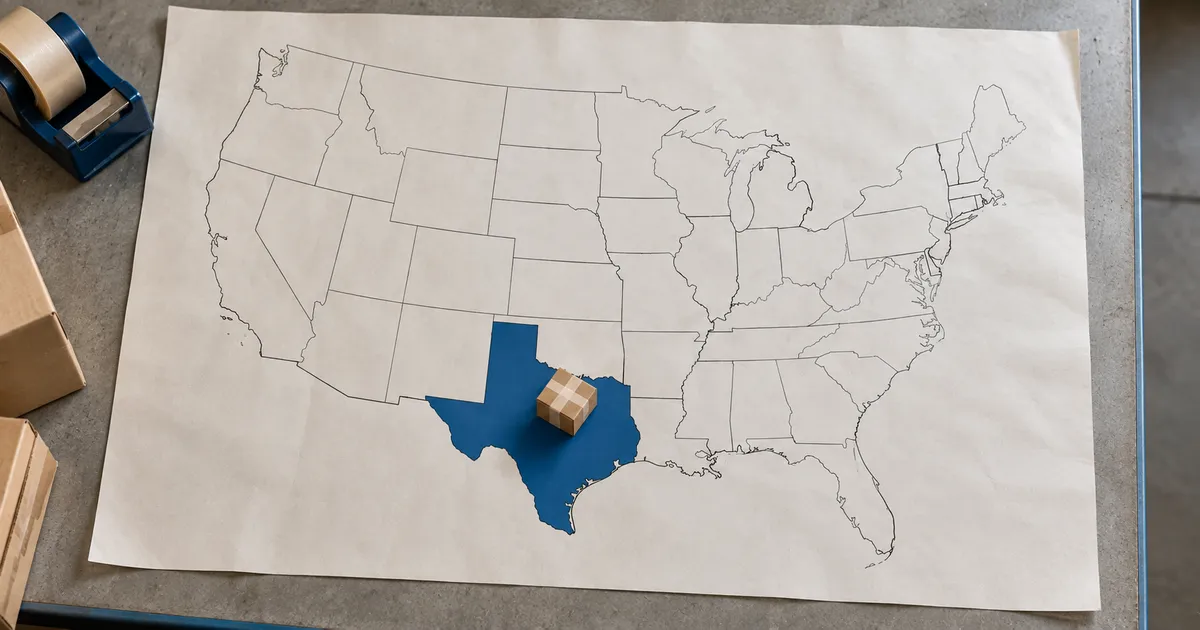
Texas already gave the world brisket, cowboy boots, and the idea that everything should come a little bigger. Here's one more thing it does better: shipping. If you sell online and your customers live all over the country, a Texas 3PL might be the smartest move you make this year, even if you've never set foot in the state. This isn't state pride talking. It's maps, math, and money.
Why a Texas 3PL wins on distance
Carriers price ground shipping by zones. Zone 2 is near the warehouse. Zone 8 is the other side of the country. The higher the zone, the more the label costs and the longer the box rides.
How much more? In one 2026 rate breakdown, a 5 pound USPS Ground Advantage package ran about $7.50 to zone 2 and about $14 to zone 8 (atoship). Same box, nearly double the postage. Multiply that across a year of orders and your warehouse address becomes one of the biggest shipping decisions you make.
It's the same reason fulfillment keeps moving closer to customers, which we covered in The Warehouse Next Door. Texas just happens to be close to a lot of customers at once.
So we ran the numbers ourselves. We took every city in the lower 48 with 15,000+ residents, weighted each one by population, and estimated its shipping zone from five popular warehouse locations.
| Warehouse in | Customers in the far zones (7 and 8) |
|---|---|
| Fort Worth, TX | About 1 in 5 (19%) |
| Chicago, IL | About 1 in 4 (25%) |
| Atlanta, GA | About 1 in 4 (26%) |
| Northern New Jersey | About 1 in 3 (34%) |
| Los Angeles, CA | Nearly 3 in 5 (59%) |
To be fair, Chicago and Atlanta are strong central picks too, and Chicago edges Fort Worth slightly on average zone. The real lesson is that the middle of the map wins. Texas pairs that position with everything below.
How we estimated this: straight line distance from each warehouse city to every lower 48 city with 15,000+ residents, weighted by population and mapped to USPS zone mileage bands. Real carrier zones follow ZIP code rules, so treat these as close estimates.
The big carriers already live here
A warehouse is only as fast as the trucks and planes leaving it. According to the Texas Comptroller, the AllianceTexas area north of Fort Worth is home to the FedEx Southwest Regional Sort Hub and Amazon Air's regional air hub. Right alongside them, BNSF's Alliance intermodal yard handled more than 1.1 million lifts (containers moved on or off trains) in 2024. In plain English, packages handed off here get into the big carrier networks fast, without a detour.
A Texas fulfillment center costs less to run
Warehouse rent shows up in fulfillment pricing whether anyone says so or not. In Q2 2026, Dallas-Fort Worth industrial space averaged $8.99 per square foot in asking rent, according to JLL. The national average in JLL's report for the same quarter was $10.45, so DFW came in about 14% cheaper. Lower building costs leave more room for fair fulfillment pricing.
Plenty of companies have done the same math. DFW absorbed about 17.9 million square feet of industrial space in the first half of 2026 alone. And if you want to see what a Texas warehouse looks like on an invoice, our rates are published on our pricing page. No sales call required to see a number.
The customers are moving here too
Texas added 391,243 residents in 2025, the most of any state, bringing the total to about 31.7 million (Texas Tribune). That's a lot of new doorsteps sitting in the cheapest zones.
Texas also borders the country's biggest trading partner. Mexico held that title for the third straight year in 2025, and Port Laredo alone handled $354 billion in two-way trade (FreightWaves). If you source products or packaging from Mexico, ecommerce fulfillment in Texas keeps your supply chain and your shipping on the same side of the map.
The fine print on choosing a Texas 3PL
No location is perfect. Here's what to know before you move inventory.
- Sales tax. Under Texas rules, storing inventory in a Texas warehouse counts as being "engaged in business" in the state, which can bring sales tax obligations (34 TAC §3.286). Loop in your accountant before the first pallet ships.
- Weather. Texas gets heat, hail, and the occasional ice storm. During the February 2021 winter storm, 2 million Texas households lost power. Ask any 3PL how they handle outages and carrier delays.
- Your customer map. If nearly all your buyers live on one coast, a warehouse on that coast may still win. Pull your orders by state before you decide.
- The 3PL itself. A great location can't fix a bad warehouse. Our 3PL red flags guide covers what to ask before you sign.
Texas 3PL FAQ
Do I need to be based in Texas to use a Texas 3PL?
No. Plenty of brands store inventory in Texas without ever visiting. You send inventory in, and orders ship out from there.
Does storing inventory in Texas mean I owe Texas sales tax?
It can. Texas treats inventory stored in the state as doing business here. Your accountant can tell you what that means for your setup.
Is a Texas 3PL cheaper than one on the coasts?
Often. DFW warehouse space runs below the national average, and a central location sends fewer orders into the priciest zones. Compare full quotes (storage, pick and pack, and shipping), not just one line item.
What if most of my customers are on one coast?
Then a warehouse near them may make more sense. A central location pays off most when orders come from all over the country.
Bigger isn't the point. Better is.
Texas is famous for doing everything bigger. For shipping, the real edge is doing it better: fewer packages riding to the far zones, carrier hubs next door, and lower costs to run the building. You don't have to move to Texas to get any of that. Your inventory does. Y'all are always welcome to visit, though.